
Search is changing faster than most businesses realise.
Google is no longer just a list of links. It’s becoming an answer engine.
And increasingly, users are skipping Google altogether and going straight to AI platforms like ChatGPT to ask questions.
If your business isn’t showing up in these AI-generated answers, you’re slowly becoming invisible.
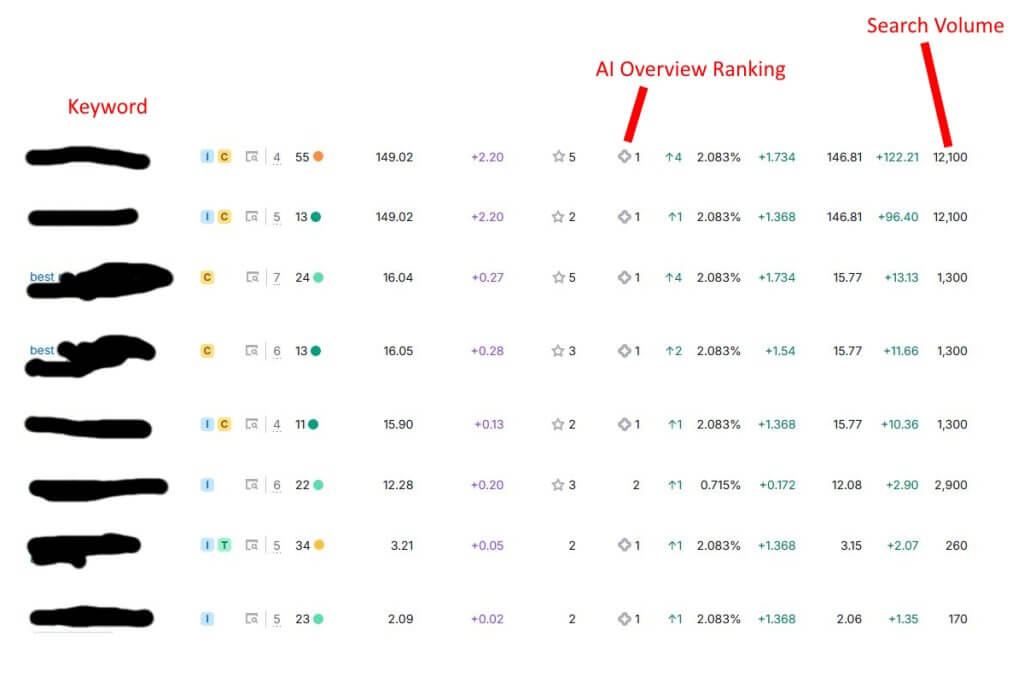
A current client’s AI rankings
The Shift: From Keywords to Answers
For years, SEO has been about keywords
- “Personal injury lawyer Brisbane”
- “Generator hire Gold Coast”
- “accountant Sydney”
But AI doesn’t work like that.
AI systems (Google AI Overview, ChatGPT, etc.) are designed to:
- Understand questions
- Synthesize answers
- Recommend trusted sources
Google is now:
- Summarising answers
- Recommending businesses
- Pulling authority signals from across the web
This means ranking is no longer about keywords.
It’s about being the most trusted answer.
What AI Actually Looks For
AI platforms don’t “rank” pages in the traditional sense.
They select sources based on trust and authority.
Google uses what’s known as the E-E-A-T framework:
- Experience
- Expertise
- Authoritativeness
- Trustworthiness
If your content doesn’t demonstrate these clearly, you won’t be included in AI-generated answers.
There really is no secret. And yep, I know that’s the politician’s answer, but it’s true.
We work hard to research what works and what doesn’t – and one of the main elements is making it easy for your target AI to cite you.
Which leads us to this: Which AI are you targeting?
Because finance people use different chatbots to travellers who use different AI to the over 60s crowd.
Getting cited by AI requires an effort – being easy to be found and retrieved by AI, to appearing in the places that AI uses, to formatting your content the correct way.
Sorry, it’s not a clean and simple answer, but getting cited in AI is a bit of work across a whole range of areas.
Having said that, the value of being cited in AI even outweighs the benefits of being top-ranked in Google. So it’s well worth the effort.
Yes, traditional SEO is still the foundation of ranking in AI-powered search.
AI platforms like Google AI Overview and ChatGPT rely heavily on trusted, well-optimised websites when generating answers.
Technical SEO, fast-loading pages, keyword relevance, quality backlinks, and topical authority all continue to play a major role in visibility across both traditional and AI search results.
You have to keep doing what you’ve been doing, and then some.
Content that performs best in AI search is:
Clear and conversational
Highly specific
Structured with headings and FAQs
Focused on solving real user questions
Backed by expertise and authority
Long-tail questions and detailed answers are particularly effective because AI tools are designed to summarise and deliver direct responses to users.
Websites that consistently publish useful, trustworthy content are more likely to be cited in AI-generated answers.
Good question – glad I asked it!
AI platforms are changing how people search online, but they are not completely replacing Google.
Instead, users are increasingly using tools like ChatGPT, Google AI Overview, Gemini, and Claude to get faster answers and recommendations.
Businesses now need to optimise for both traditional search engines and AI-powered platforms to maintain visibility and stay competitive online.
The #1 Strategy: Build Content Clusters
If you want to rank in AI, you need to own topics – not just pages.
Old SEO approach:
One page targeting one (maybe another slight variation) keyword.
AI-first approach:
A content cluster that answers every related question – an example for a personal injury lawyer in Brisbane might be:
- How much compensation for a slip and fall claim in Brisbane?
- What should I do after a slip and fall?
- How long does a claim take?
- Do I have a valid claim?
- Can I sue for slipping at work?
Each page targets a specific question.
Together, they signal that the website is an authority on the topic.
Make sense?
Why Content Clusters Work for AI
AI tools don’t just look at one page.
They look at:
- Depth of coverage
- Consistency of answers
- Internal linking
- Topical authority
When you build clusters:
- You increase your chances of being cited
- You give AI structured, extractable answers
- You position your brand as a trusted source
This is exactly how businesses begin appearing in:
- Google AI Overviews
- Featured snippets
- ChatGPT-style responses
Structure Content for AI Extraction
It’s not just what you write — it’s how you structure it.
AI prefers content that is:
- Question-led (H2s as questions)
- Concise and direct
- Well structured
- Easy to summarise
Example:
Bad:
A long paragraph explaining everything.
Good:
What should I do after a slip and fall?
- Seek medical attention
- Report the incident
- Document evidence
- Speak to a lawyer
This format is far more likely to be pulled into AI answers.
Authority Layering: The Missing Piece
Most businesses fail here.
AI doesn’t trust content alone — it looks at who is behind it.
To rank in AI, you must build:
1. Expert Profiles
- Detailed author bios
- Credentials
- Real-world experience
2. Proof of Work
- Case studies
- Results
- Real examples
3. External Signals
- PR mentions
- Reviews
- Citations across the web
This is how you move from just another website, to a recoghnised authority AI will reference.
Schema & Technical Signals Matter
AI relies heavily on structured data.
You should implement schema for:
- FAQs
- Services
- Reviews
- Authors
This helps AI:
- Understand your content
- Extract answers more easily
- Trust your information
Digital PR: Get Others Talking About You
AI doesn’t just trust what you say — it trusts what others say about you.
That’s why:
- PR mentions
- Directory listings
- Industry citations
…are critical.
Authority is built when multiple sources reference your business.
The Future of Search
This isn’t a trend — it’s a shift.
- Google is becoming an AI answer engine
- Users are moving to ChatGPT and similar tools
- Traditional SEO alone is no longer enough
If you want to rank in AI:
- Stop trying to rank pages
- Become the answer
Want Help Ranking in AI?
At Tailored Media, we help businesses restructure their entire online presence to:
- Rank in Google AI Overview
- Appear in AI chatbot responses
- Build long-term authority
Get in touch (phone 07 5534 1228 or use the form below) to see how your business can become the trusted source AI recommends.